One airplane or three platforms: how training aircraft matter
Most schools put a student in one airplane for the whole certificate. What changes when you fly two glass-cockpit Cessnas and an FAA-approved simulator instead.
By Watch Me Fly Academy
Most flight schools train a student almost entirely in a single airplane. A pilot who has only ever flown one airplane is comfortable in exactly one cockpit. Watch Me Fly Academy trains across three platforms instead, and the reason is not variety for its own sake.
Romeo — the Cessna 172M, N5094R
Romeo is a 1974 airframe carrying a modern panel: a Dynon SkyView HDX system coupled with an Avidyne IFD 440 GPS navigator, a two-axis autopilot with GPS roll steering, and ADS-B In/Out putting traffic and weather in front of the pilot. It meets the FAA definition of a Technically Advanced Aircraft, and ten hours in a TAA or complex aircraft help qualify a pilot for the commercial rating. This is where instrument and commercial students integrate everything — IFR cross-countries, night operations, automation management, checkride prep.
Roxanne — the Cessna A150M Aerobat, N8195V
Roxanne is the smallest airplane in the fleet and one of the most capable. She carries a glass panel, GPS navigation, a moving map and an integrated two-axis autopilot at a significantly lower operating cost than the 172, which is what makes cross-country time affordable. She is also an aerobatic airframe, and she is where students get spin awareness, spin recovery and upset recovery training — firsthand experience of recovering from situations most pilots only ever discuss in a classroom.
Dexter — the Redbird LD in The Flight Lab™
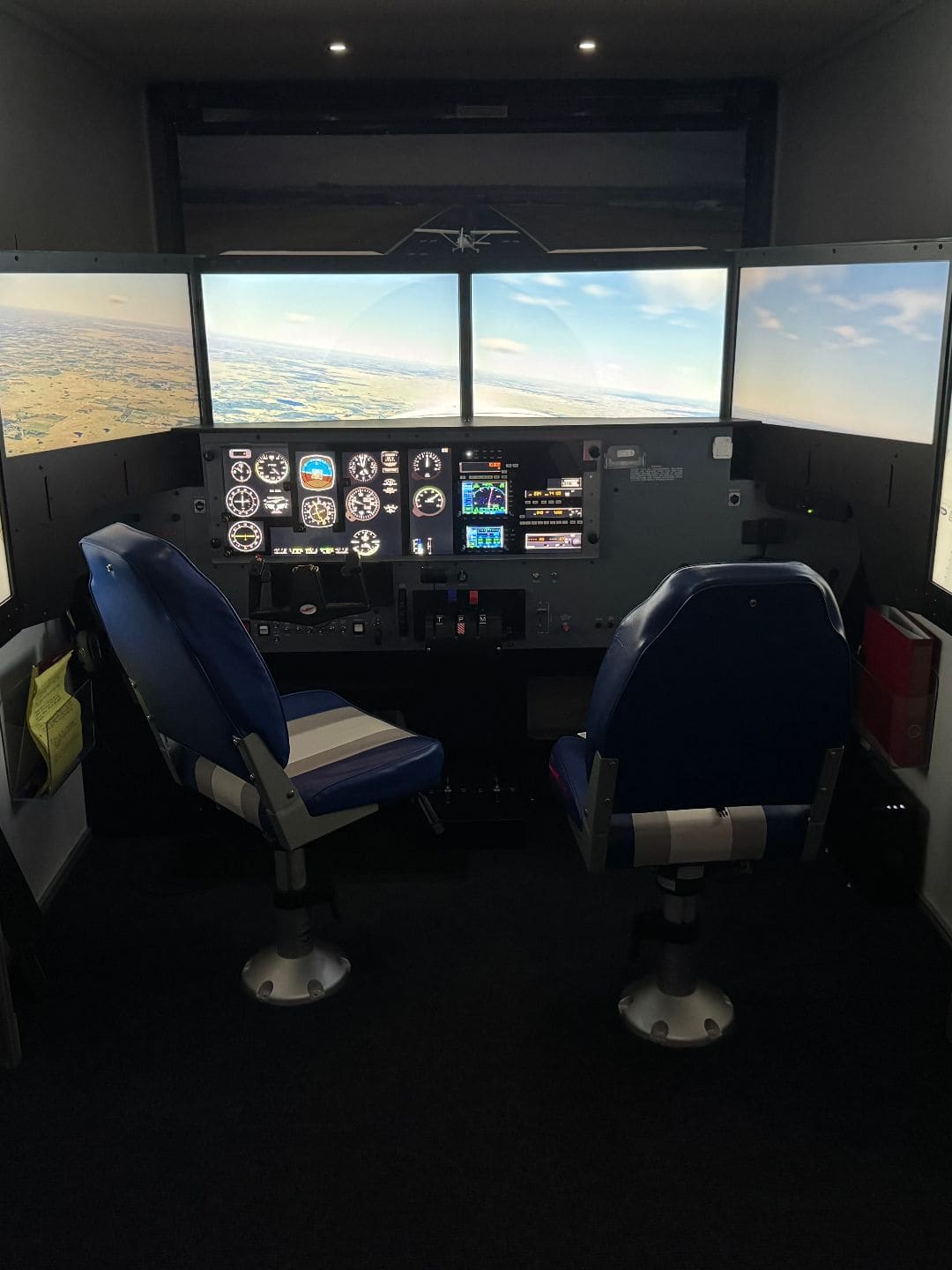
Dexter is an FAA-approved Redbird LD AATD, housed in The Flight Lab™, our mobile aviation training center. It can be configured as a traditional six-pack Piper Archer or as a glass Cessna 172 G1000, costs roughly half as much to operate as a training aircraft, and logs instrument approaches toward IFR currency in accordance with FAA regulations.
What the simulator is really for is the day something goes wrong. Engine failures, electrical and vacuum failures, instrument malfunctions, deteriorating weather, lost communications and spatial disorientation are all rehearsed in Dexter until the correct response is automatic — including live air traffic control simulation, so radio work is practiced with real people acting as ATC before a student ever keys the mic for real.
Why it makes the flying cheaper, not more expensive
Students who arrive at a flight lesson already knowing the procedure spend the paid hour flying it rather than learning it. The FAA also permits up to 20 hours of Instrument Rating training in an approved AATD, and the Instrument package uses that allowance rather than putting every approach in the airplane.
The whole arrangement sits inside the fixed Smart Path package price — the Private package is $12,845 across all three platforms. Full specifications for both airframes and the simulator are on the fleet page. One flight in any of them is usually enough to know whether this is for you: a Discovery Flight is $215, or call 737-256-7305.