Straight answers before you book.
Everything students ask us most — costs, the aircraft, the location, and how to start. If your question isn't here, call 737-256-7305 and ask a person.
Cost
How much does it cost to earn a Private Pilot License?
$12,845. That is the fixed price of our Smart Path Private Pilot package, and it includes 60 hours of training — 25 hours in the Cessna A150M Aerobat, 20 in the glass-cockpit Cessna 172 and 15 in the Redbird simulator — plus 30 hours of instructor time, the Sporty’s Learn to Fly course, written-test prep and endorsement, spin and upset recovery training, a final mock checkride and the aircraft rental for your FAA practical test (up to 3 flight hours). Many traditional flight schools quote $16,000–$22,000 for the same certificate.
How long does it take to get my license?
Mostly it comes down to how often you fly. Students who train consistently finish soonest, because they spend less time relearning skills — and with flight operations from 6am to 10pm seven days a week and availability kept ahead of demand, a consistent schedule is achievable here. Our focus is never on rushing you through, but on making sure you have mastered each skill before moving on, so we would rather talk about your schedule than quote you a number we cannot stand behind.
Can I finance my flight training?
Yes. We work with Stratus Financial, a lender specialising in flight-training loans, and the Watch Me Fly Foundation offers scholarships for students beginning or continuing their training. Because Smart Path packages are fixed-price, you know exactly what figure you are financing before you apply — terms, rates and approval are set by the lender.
What does financing actually cover?
Financing through Stratus Financial is arranged between you and the lender, so what it covers depends on the amount you are approved for. On our side the Smart Path package price is fixed and covers aircraft, simulator and instructor time up to the included hours, the Sporty’s ground course, written-test prep and endorsement, a final mock checkride and the aircraft rental for your FAA practical test (up to 3 flight hours). Your FAA medical, the knowledge-test fee, the examiner’s fee and personal equipment such as a headset are not included in the package price.
Do I need to finance the whole program up front?
No. You can pay for a Smart Path package outright, finance it through Stratus Financial, or simply start with a $215 Discovery Flight and decide afterwards. If you need training beyond the hours included in your package, you continue at discounted Smart Path member rates rather than buying a second package.
Getting started
Do I need any previous experience to start?
No. Most of our students arrive with no flight experience at all, and a Discovery Flight is built for exactly that — you fly with a Certified Flight Instructor beside you and no prior training, license or hours are required. What you need is the wish to find out.
What is a Discovery Flight?
It is a real first lesson, not a sightseeing ride: you sit in the pilot’s seat, take the controls, and fly a glass-cockpit training aircraft with one of our instructors guiding you. Our Enhanced Discovery Flight is $215, the time is loggable toward your certificate, and there is nothing to commit to afterwards.
Is it safe?
Yes. You fly with a Certified Flight Instructor who has a full set of controls and takes them the moment anything needs it, in aircraft maintained to professional standards. Beyond that, we deliberately train for the day something goes wrong — spin awareness, spin recovery and upset recovery in our Cessna A150M Aerobat, and engine failures, electrical and vacuum failures, instrument malfunctions, lost communications and deteriorating weather rehearsed in our FAA-approved Redbird simulator until the correct response is second nature. And when the weather is not right, we reschedule.
How do I get started?
Call 737-256-7305 or email michael@watchmefly.academy and we will talk through where you are headed and what it takes to get there. Most people begin with a Discovery Flight — $215, one flight, one instructor, and nothing to commit to afterwards.
Can friends or family come and watch?
Ask us when you book — call 737-256-7305. Ramp access at San Marcos Regional Airport is governed by airport rules and by what else is operating that day, so we will confirm what is possible for the day you fly rather than promise something we cannot deliver.
The airplanes
What aircraft will I train in?
Both of ours, plus the simulator. Students fly N5094R “Romeo”, a 1974 glass-cockpit Cessna 172M, and N8195V “Roxanne”, a glass-cockpit Cessna A150M Aerobat — both Technically Advanced Aircraft — and train in Dexter, our FAA-approved Redbird LD. Most schools train you almost entirely in one airplane; we think real pilots fly more than one.
How old are the airplanes, and how are they maintained?
N5094R is a 1974 Cessna 172M, substantially upgraded with an all-glass Dynon SkyView HDX panel, an Avidyne IFD 440 GPS navigator, a two-axis autopilot and ADS-B In/Out. N8195V is a Cessna A150M Aerobat, also glass-panel and TAA-capable. Both are maintained to professional standards and inspected on the schedule the FAA requires of training aircraft.
How many aircraft do you have, and will I always get one?
Two aircraft and an FAA-approved simulator, flown by a team of four instructors, with flight operations running 6am to 10pm seven days a week. We deliberately keep aircraft and instructor availability ahead of demand, so students are not competing for limited slots — which means more consistent flying, fewer interruptions and better skill retention.
Will I train in the same airplane every lesson?
No, and that is the point. Smart Path students learn and practice nearly every major maneuver in both the glass-cockpit Cessna A150M Aerobat and the glass-cockpit Cessna 172, and rehearse emergencies in the Redbird simulator. Pilots who only ever fly one airplane are comfortable in exactly one cockpit; we would rather you were comfortable in more than one.
Do the aircraft have glass cockpits or steam gauges?
Glass — both of them. The Cessna 172 carries a Dynon SkyView HDX panel with an Avidyne IFD 440 GPS navigator, a two-axis autopilot with GPS roll steering and ADS-B In/Out; the Aerobat has a modern glass panel, GPS moving map and integrated two-axis autopilot. Both meet the FAA definition of a Technically Advanced Aircraft. Dexter, our Redbird simulator, can be configured either way: a traditional six-pack Piper Archer or a glass Cessna 172 G1000.
Training & the airfield
Do I need a medical certificate?
You do not need one for a Discovery Flight, but you will need at least an FAA medical certificate before you fly solo, so it is worth starting that process early. It is issued by an FAA-designated Aviation Medical Examiner and sits outside the Smart Path package price.
Are you a Part 61 or Part 141 school?
Part 61. That gives us the flexibility to build training around your schedule and your pace, while the Smart Path packages supply the structure — a milestone-based curriculum at a fixed, published price.
Where are you located?
At 1807 Airport Dr., San Marcos, TX 78666, on San Marcos Regional Airport (KHYI) — about 35 minutes south of Austin and about 20 minutes north of New Braunfels on I-35. We train students from across the greater Austin area.
Can flight training be a career?
Yes, and here it is a mapped route rather than a hope. You train Private, Instrument and Commercial with us; top-performing graduates have a direct track to become a Certificated Flight Instructor with Watch Me Fly Academy, building high-quality hours while getting paid to fly; and from there the path continues to flying aerial sightseeing for Sky Tour Adventures, our sister operation. Instead of competing with thousands of outside applicants for a first flying job, you have a pipeline right where you trained.
Is there parking, and where do I go on my first visit?
We are at 1807 Airport Dr., on San Marcos Regional Airport (KHYI), just east of I-35. Airports can be confusing the first time, so call 737-256-7305 before your first visit and we will tell you exactly where to park and where to meet your instructor.
Which airport do you fly out of?
San Marcos Regional Airport — KHYI — at 1807 Airport Dr., San Marcos, just east of I-35 roughly halfway between Austin and New Braunfels. It has its own weather reporting, which you will see in the live conditions strip at the top of this site.
Take your time with it.
There is no rush and no wrong question. Work through the list above — then call, and a person will answer the rest.
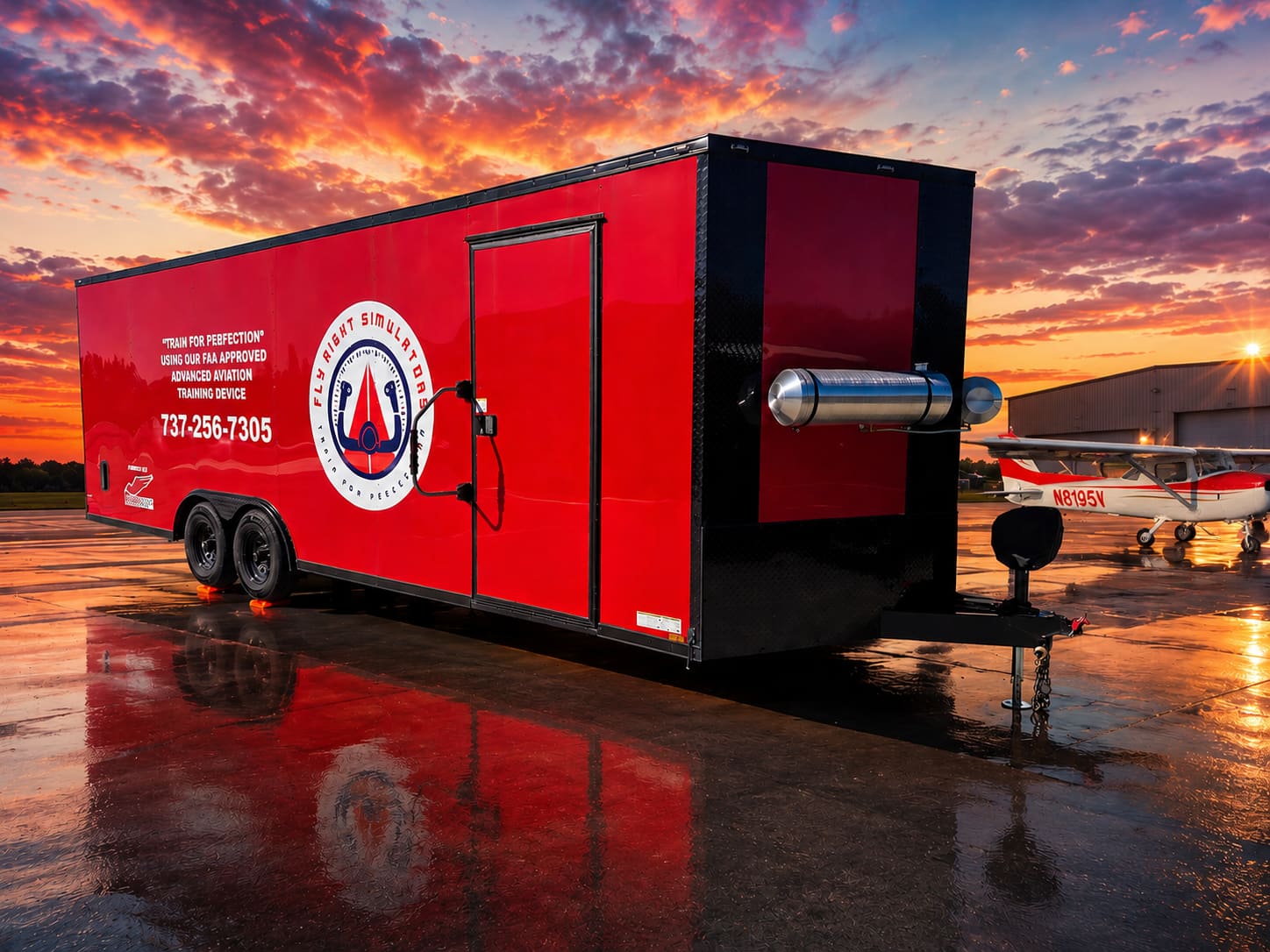 Watch Me Fly · San Marcos Regional Airport at golden hour
 Still have a question?
Reach out through the contact page — or just call. We'll help you determine the best next step.
Serving Austin · Kyle · Buda · New Braunfels